Tuesday, May 20, 2025

Lease - keep your down payment low because your lease amount is the Same

 If you have great credit and plenty of cash, it is generally better to keep your down payment low when leasing a car rather than making a large down payment like $10,000. Here’s why:

  • Lowering your monthly payment with a large down payment does not reduce the total cost of the lease.Whether you put $0 or $10,000 down, the total amount paid over the lease term is about the same—the down payment just shifts when you pay, not how much you pay overall24.

  • Leasing does not build equity. Unlike buying, you do not own the car at the end of the lease, so a large down payment is not recouped56.

  • Risk of loss if the car is totaled or stolen. If the vehicle is wrecked or stolen early in the lease, your down payment may not be fully reimbursed, even if you have GAP insurance6.

  • Most experts recommend putting as little down as possible on a lease, only enough to meet the required upfront costs and keep monthly payments manageable567.

Bottom line: With strong credit and sufficient cash, you should generally keep your lease down payment to the minimum required. This approach protects your cash and reduces risk without increasing your total lease cost24567.

Citations:

  1. https://www.toyotaplace.com/finance/buying-vs-leasing/
  2. https://www.reddit.com/r/askcarsales/comments/1dft3w1/why_no_down_payment_for_a_car_lease/
  3. https://cars.usnews.com/cars-trucks/car-loans-and-leasing/car-lease-calculator
  4. https://www.edmunds.com/car-leasing/should-you-make-a-down-payment-when-you-lease.html
  5. https://www.autotrader.com/car-shopping/whats-right-down-payment-car-loan-or-lease-212702
  6. https://www.lithia.com/research/car-leasing/should-you-make-a-down-payment-when-you-lease-a-car.htm
  7. https://www.dmautoleasing.com/blog/pros-and-cons-of-a-down-payment-on-a-car-lease/
  8. https://www.victorysanbruno.com/buying-vs-leasing/

Answer from Perplexity: pplx.ai/share


Does Capsaicin Affect Birds?

Birds are largely unaffected by capsaicin, the compound responsible for the "heat" in chili peppers that causes burning sensations in mammals.

Biological Basis

  • Birds lack the specific capsaicin-sensitive TRPV1 pain receptors found in mammals. While both birds and mammals have heat-sensitive TRPV1 channels, only the mammalian version responds to capsaicin, making birds immune to its burning effects136.

  • As a result, birds cannot taste or feel the irritation from capsaicin, and it does not cause them discomfort or pain23489.

Practical Implications

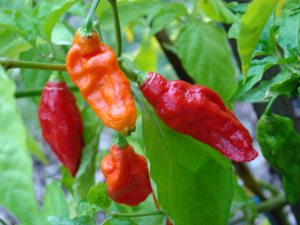
Wrinkled Bhut Jolokia chili peppers in varying stages of ripeness, including red and orange, growing on a plant
  • Capsaicin is often added to birdseed to deter mammals like squirrels and raccoons, as they find it unpleasant, while birds eat the treated seed without issue3578.

  • Studies and anecdotal evidence indicate that capsaicin does not harm birds or damage their mouth, eyes, or digestive tract37.

  • Birds can consume even the hottest peppers, such as the Carolina Reaper or Bhut Jolokia, without adverse effects2.

Evolutionary Perspective

  • The insensitivity of birds to capsaicin is thought to be an evolutionary adaptation. Chili plants benefit when birds eat their fruit and disperse the seeds, as birds do not destroy the seeds during digestion, unlike mammals1356.

  • This mutual relationship helps chili plants propagate while deterring seed-destroying mammals.

Safety Considerations

  • There is no evidence that capsaicin causes direct physical harm to birds. Commercial capsaicin-treated bird foods have been used for years without reports of negative impacts on bird populations37.

  • Some sources note that while birds are immune to the pain of capsaicin, the possibility of other, subtle health effects has not been entirely ruled out, though no empirical data suggests harm310.

Summary Table

Effect of Capsaicin on BirdsDescription
SensationNo burning, pain, or irritation
TasteCannot taste capsaicin
Digestive ImpactNo evidence of harm or discomfort
Use in Bird FeedSafe and effective for deterring mammals, not birds
Evolutionary RolePromotes seed dispersal by birds, deters mammals

Conclusion

Capsaicin does not affect birds in the same way it affects mammals. Birds are immune to its burning and irritating effects, making it safe for them to consume spicy peppers and capsaicin-treated foods. This unique insensitivity is both a biological and ecological adaptation that benefits both birds and certain plants12368.

Citations:

  1. https://www.reddit.com/r/askscience/comments/1bvliuj/are_birds_completely_immune_to_capsaicin/
  2. https://www.perkypet.com/articles/why-birds-are-immune-to-the-burn-of-hot-peppers
  3. https://winnipeg.wbu.com/hot-pepper
  4. https://eugene.wbu.com/birds-and-hot-pepper
  5. https://en.wikipedia.org/wiki/Capsaicin
  6. https://pubmed.ncbi.nlm.nih.gov/11853675/
  7. https://www.reddit.com/r/spicy/comments/iv6yw6/birds_cant_taste_capsaicin_but_is_it_still_bad/
  8. https://npic.orst.edu/factsheets/capgen.html
  9. https://www.youtube.com/shorts/Pw3gFL-YcCI
  10. https://www.birdwatchersgeneralstore.com/hot-pepper-bird-seed-is-not-worth-the-risk/

Answer from Perplexity: pplx.ai/share